
Landscape Lighting DFW
Trees, paths and outdoor spaces, thoughtfully lit for the way you live after dark.
Plan one focal tree, a welcoming front yard or a connected patio and pool area. Tell us what you want to see, where you spend time and whether there is an outdoor outlet nearby. Your free quote starts with your property, not a one-size-fits-all fixture package.
A layered plan, not just more lights.
Good landscape lighting in DFW connects the architecture, planting and places people actually use. Walk the property after sunset before choosing fixtures. Note the dark turn in the walkway, the tree you would like to see from the living room and any light already coming from porch fixtures or the street. These observations help prevent overlighting and unnecessary equipment.
Choose a few priorities first. A clear entrance, a readable path and one strong focal point can be more effective than evenly lighting everything. Consider neighboring windows, irrigation, future planting and access for maintenance. The design should look comfortable from the curb and from inside your home, with wiring and power planned before installation begins.
Five areas worth planning carefully.
Tree uplighting
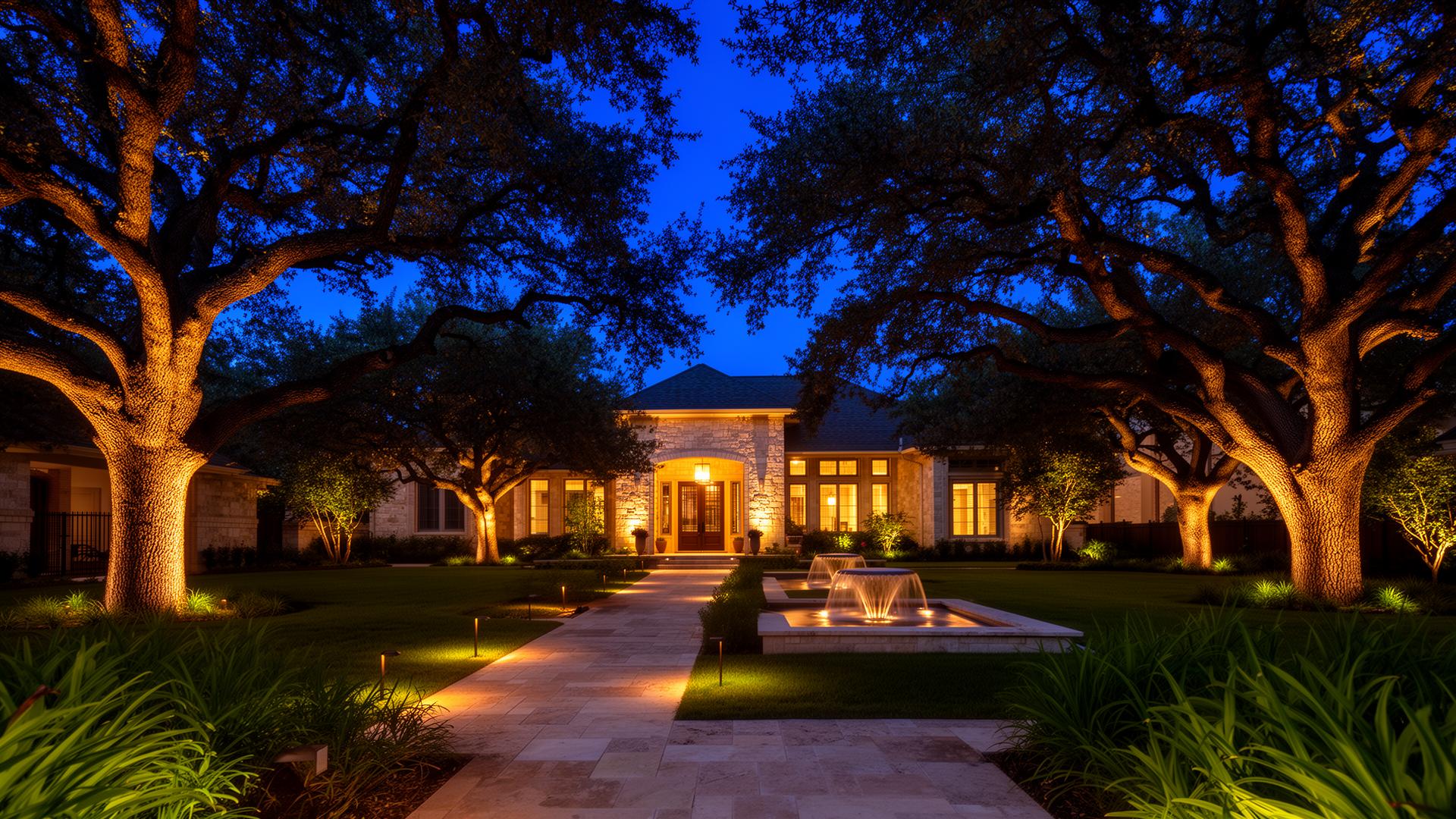
A mature oak, magnolia or ornamental tree can become the focal point of a front yard after sunset. Uplighting starts near ground level and aims into the trunk and canopy. The useful question is not simply how bright the fixture is: it is which part of the tree should be visible from the street, the front door and your windows. A wide canopy and a narrow ornamental tree need different beam choices.
Ask the designer to view each tree from more than one angle. A single beam can create an attractive silhouette, while a broader composition may need several carefully aimed fixtures. Avoid exposed light sources facing a driveway or neighboring windows. Leave space for roots and changing plant growth, and choose positions that will remain accessible for cleaning and adjustment without putting fixtures in the mower's path.
Explore tree uplightingPath lights
Path lights should help people read the route from parking to your door, not turn every flower bed into a bright runway. Focus on turns, uneven transitions, steps and the places where guests need to make a decision. Alternating positions can feel more natural than matching pairs along the entire walk. Fixture spacing should follow the actual beam pattern and site conditions rather than a fixed number of feet.
Low glare matters because guests look toward the entrance as they walk. Shielded fixtures can put light on paving while keeping the lamp out of view. Check whether shrubs will hide the beam as they grow, and whether sprinklers or lawn equipment will repeatedly hit the fixture. A small, well-planned route can be a sensible first phase of a larger landscape project.
Explore pathway lightingEntry and facade wash
An entry should feel welcoming without making the front door the brightest object on the property. A soft facade wash can connect the doorway to nearby columns, brickwork or stone. Lighting a textured wall from close range emphasizes its surface; lighting from farther away creates a more even wash. The right approach depends on the architecture and whether you want texture, a broad glow or a focused accent.
Review the effect from inside the house as well as outside. An uplight placed directly below a window may create uncomfortable glare in the room. Dark gaps, hot spots and beams spilling across the property line are reasons to adjust the plan, not simply add more fixtures. Keep decorative lighting distinct from any functional entry or security lighting so each has an appropriate purpose and schedule.
Explore entry and security lightingPatio and outdoor living areas
Patios need a different balance from a front yard. People sitting at a table are close to the fixtures, so a beam that looks subtle from the curb can feel harsh from a chair. Start with the way you use the space: dining, cooking, relaxing or getting between the house and yard. Light steps and circulation separately from the softer light around seating and surrounding plants.
Landscape accents can give an outdoor room depth without flooding the entire area. Bistro lighting is another option for overhead ambience, but its supports, electrical supply and weather exposure need their own review. Ask which parts of the proposal are low-voltage landscape lighting and which are a separate patio installation. Confirm controls instead of assuming every light will use the same app or transformer.
Explore patio and bistro lightingPool areas
Pool-area landscape lighting can highlight surrounding trees, planting beds and the route between the house and pool deck. Reflections on water add depth, but a visible lamp aimed across the pool can be distracting. Review the view from seating, the house and the far side of the deck. A restrained perimeter often works better than making every surface equally bright.
Water changes the safety requirements. Do not assume a standard garden fixture can be placed anywhere near a pool, or that an existing pool circuit can power new landscape lights. The installer and, where necessary, an electrician must review suitable equipment, placement and the applicable requirements. Underwater lights and pool electrical repairs are separate from lighting the landscape around the pool. Include those boundaries in the written scope.
See related outdoor living lighting optionsWhat goes into your landscape quote?
Fixture count is only part of the cost. The quote should identify the areas covered, fixture and lamp choices, transformer capacity, cable routes and installation access. A short walkway beside an existing outlet is different from several mature trees across a driveway. Ask whether timers or other controls are included, and whether any electrician work is separate.
- Per fixture
- [price per fixture]
- Starter package
- [starter package]
- Full front yard
- [typical full front yard]
Confirmed pricing is pending. Request an itemized quote for your property.
What power do I need?
Low-voltage landscape lights run from a transformer that plugs into an exterior GFCI-protected outlet. The transformer reduces household power to the voltage required by the selected lighting equipment. It needs a suitable mounting location, outdoor-rated equipment and a planned cable route. An outlet that exists is not automatically usable: condition, protection, accessibility and the equipment instructions all matter.
If there is no usable outlet near the install area, an electrician adds one first. We can recommend an electrician and schedule the lighting work around that visit. Share a photo of the likely outlet and a wider photo showing the yard; do not open electrical boxes or modify wiring yourself. The electrician checks the supply and determines the appropriate outlet, protection and any circuit work.
Distance affects the low-voltage side too. Longer runs can lose voltage, and the fixture load, wire size and route determine how the system should be designed. There is no universal maximum distance to quote without checking the equipment. A closer outlet may simplify the project, but the design review should establish that before electrical work is booked. Extension cords are not a substitute for a suitable permanent supply.
Read the DFW outdoor outlet guideLandscape + permanent roofline lighting.
Landscape lighting gives the yard depth; permanent roofline lighting defines the home above it. Plan both together to balance brightness and warm-white accents instead of allowing one system to overpower the other. Roofline scenes can change for Christmas, Halloween, July 4th and game days while the landscape remains welcoming and functional.
You can install both in one project or phase the work. Ask for separate scope and power details for each, and confirm whether the selected controls work together. A bundled design does not mean a shared transformer or identical warranty. The permanent system uses the Astoria Lighting app; landscape control options depend on the specified equipment.
Explore permanent roofline lightingBefore installation: a practical checklist.
- Photograph the areas to light and any nearby exterior outlet.
- Identify paths, steps, seating and views you use after dark.
- Check HOA requirements; complete and submit your own form if approval is needed.
- Confirm fixture locations, cable routes and separate electrician costs in writing.
- Leave access around planting and agree how future expansion will work.
- Review aiming and schedules after dark, and retain equipment and service details.
Landscape lighting FAQs
More from the journal
Beautiful lighting starts with a free design visit.
We come to your home, walk the property, and design a layout customized to your architecture — at no cost.